2015
5th Munich Earth Skience School
Berghotel Sudelfeld
www.berghotel-sudelfeld.de
February 22-27, 2015
What a MESS! ObsPy meets seismic simulation!
| What is under the hood of current seismic simulation software (e.g., seissol, axisem, specfem) aiming at 3-D wave propagation solutions? The goal of this winter school is to teach elements of numerical methods that constitute current elastic wave simulation software. The methods we will discuss include the finite-difference method, aspects of pseudospectral methods and the spectral element method, as well as the Discontinuous Galerkin Method. We will address questions like 1) What is numerical dispersion, how can I recognise it and how can I avoid it? 2) What operators should I use for accurate simulations? 3) How do the methods compare and what are their domains of application? 4) What are the main mathematical differences of the methods and what is the impact on the applications? The differences of the various methods will be illustrated with simple 1D (or 2D) codes written in Python. Results will be visualized and analyzed with Python/ObsPy. The goal is NOT to make you familiar with specific community simulation software but to make you aware of some of the traps in forward modelling by highlighting the key mathematical features of the methods (finite differencing, numerical interpolation and integration, harmonic averaging, convergence behavior, etc.). Target participants are senior undergraduates, junior postgraduates interested in using simulation software and researchers making use of community codes who are interested in the underlying methodologies. Participants will be provided with a book draft on this winter school’s topics. | 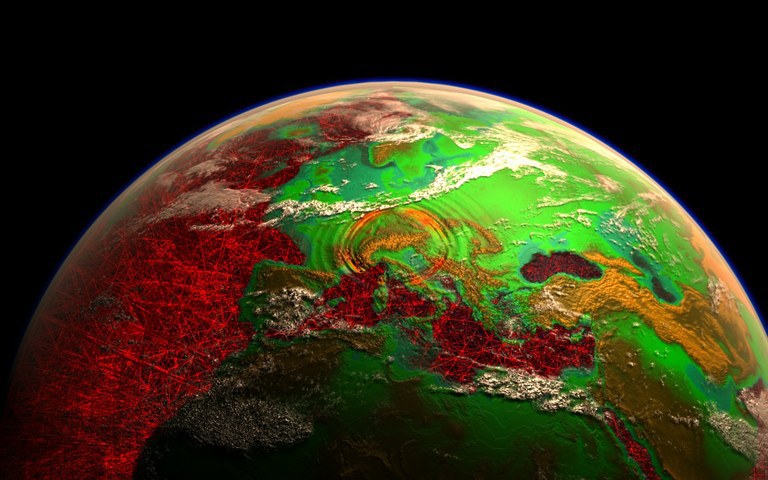 Snapshot of elastic wave propagation using the Discontinuous Galerkin method (seissol). The underlying tetrahedral grid is illustrated in the Earth’s interior. Snapshot of elastic wave propagation using the Discontinuous Galerkin method (seissol). The underlying tetrahedral grid is illustrated in the Earth’s interior. |
|---|
Lecturers/Tutors: Prof. Dr Heiner Igel (LMU), Lion Krischer (LMU), Tobias Megies (LMU), Stephanie Wollherr (LMU)
Practical information: Lectures, practicals will be given from 8-11 and after 3pm (open end). Between 11 and 3 (depending on conditions, winter sports facilities can be used, www.sudelfeld.de). More info on the winter sport programme can be found here.
Costs: 410 € (incl. 5 days half pension, conference facilities, tuition, software). Arrival Sunday 22/2 leaving Fri 27/2 (lunch time). Note that the costs do not cover: lunch, drinks during meals, winter sports facilities. The number of participants is limited to ~30. First come, first serve basis. The area can be reached by train from Munich Airport (terminal station: Bayrischzell).
Logistics: Please make your way to Bayrischzell Station on Sunday 22nd afternoon, unless you come with your own vehicle. We will provide a shuttle service from the train station to the hotel.
Tentative schedule:
| Morning 8-11 | Afternoon 15-18 | Evening 20-open end | |
| Sun 22 Feb | Arrival – Icebreaker at 18:00 | Opening | |
| Mon 23 Feb | Python Introduction | ObsPy Introduction | |
| Tue 24 Feb | Why? – wave equations – numerical methods – discretization – finite-difference method – Taylor operators – Courant criterion numerical dispersion | acoustic wave equation – numerical anisotropy – heterogeneous models | Bogner Ski night (movies), Ski gynastics with Vorderwülbecke |
| Wed 25 Feb | Orthogonal functions – interpolation – spectral derviatives – collocation points – cardinal functions – the Fourier method | Free Afternoon – Parallel slalom | Special dinner |
| Thu 26 Feb | Weak form – Lagrange interpolation – Gauss quadrature – mass and stiffness matrices – the spectral element method | Advection equation – nodal discontinuous Galerkin method – flux schemes | Mulled wine |
| Fri 27 Feb | Computational seismology – applications of finite-difference, spectral element, and discontinuous Galerkin methods: strong ground motion, volcanology, global seismology, seismic exploration, full waveform inversion, dynamic rupture. |
If you have questions please contact heiner.igel@lmu.de.